Pages

Tampilkan postingan dengan label gender. Tampilkan semua postingan

Race, Gender, & Sexuality in HIV Prevention Campaigns

via The Society Pages, by Christie Barcelos

Gay men and bisexual men still represent a disproportionate number of HIV cases in the United States (CDC). In addition, African-American and Latino men are significantly more likely than white men to be diagnosed with HIV and die from AIDS-related illnesses. Numerous HIV prevention campaigns are thus aimed at these populations.

It’s important to try to reduce the HIV among these populations, but we also need to think critically about how prevention strategies reinforce stigmatization.

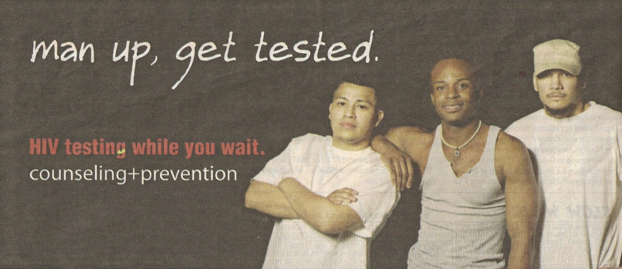
For example, this ad from a western Massachusetts clinic uses the phrase “man up, get tested” — taking care of yourself by getting tested for HIV is linked to your masculinity. What’s interesting is that by including only men of color in the photo, the ad suggests that black and Latino men are particularly obsessed with their masculinity, more so, perhaps, than white men. It also potentially reinforces stereotypes about black men as hyper-sexualized and Latino men as machismo.


[If an item is not written by an IRMA member, it should not be construed that IRMA has taken a position on the article's content, whether in support or in opposition.]

Searching for a Transsexual Community


Settling into 'full-time' living, I stepped away from the places where I'd explored my gender, spending time with old friends as we intuitively worked out if my transition would affect our relationships. No longer feeling that I could only be myself in 'safe' spaces, I stopped going to 'T-friendly' mainstream gay clubs (where I was often the only T, sitting in the corner grinding my teeth as yet another musical abomination piped up), deciding that the best way to normalise my gender was to maintain as much continuity as possible with my pre-transition social life.

For the most part, this was fine. Fortunately, I lost very few friends and, being discerning about where I socialised, I encountered little friction away from the streets. Having discussed my transition so much on coming out, the resumption of long-standing arguments with old friends felt strangely cathartic. But I missed Brighton's queer scene: I no longer needed it in the same way, but I still liked the atmosphere at its events, as well as the tunes (sometimes they let me choose them, the fools) – and I'd made some good friends there.

As well as strengthening my few existing ties, I wanted to make new friends who understood the specific challenges of transsexual life. 'Tranny' nights, which felt more suited to those who would not transition (especially transvestites) didn't appeal, even before I came to define as transsexual, and I started to look beyond clubs (which often, on some level, cater for people of shared sexuality rather than gender identity) for community support.


[If an item is not written by an IRMA member, it should not be construed that IRMA has taken a position on the article's content, whether in support or in opposition.]

'Kothis' (Feminised Males) Reducing Risk to HIV and Sexual Violence

from News Blaze, by Anjali Singh

Having faced ages of neglect, denial and invisibility, "Kothis" (feminised males) are now being mobilized by groups like 'Bharosa' in Lucknow, Uttar Pradesh (India) to be empowered and demonstrate leadership in reaching out within their community for increasing access to essential services including HIV prevention, care, treatment and support services. They are routinely encouraged to practice safer sexual practices and protect themselves from any kind of abuse or exploitation.

Kothis, or feminised males, are unique and don't necessarily identify with gender identities of man, woman, or other identities now increasingly getting accepted like those of gays or men-who-have-sex-with-men (MSM). Kothis are neither gays nor eunuchs and because of this, they are outcasts in these groups and several rungs lower in social status. Thus, sans any rights within the said group, they are often severely exploited and abused.