Pages

Tampilkan postingan dengan label United Nations. Tampilkan semua postingan

The Rape of Men

via The Guardian, by Will Storr

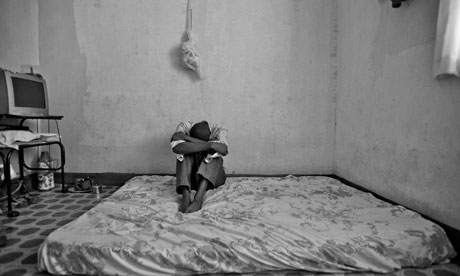
male-rape-victim-ugandaSexual violence is one of the most horrific weapons of war, an instrument of terror used against women. Yet huge numbers of men are also victims. In this harrowing report, Will Storr travels to Uganda to meet traumatised survivors, and reveals how male rape is endemic in many of the world's conflicts.

Of all the secrets of war, there is one that is so well kept that it exists mostly as a rumour. It is usually denied by the perpetrator and his victim. Governments, aid agencies and human rights defenders at the UN barely acknowledge its possibility. Yet every now and then someone gathers the courage to tell of it. This is just what happened on an ordinary afternoon in the office of a kind and careful counsellor in Kampala, Uganda. For four years Eunice Owiny had been employed by Makerere University's Refugee Law Project (RLP) to help displaced people from all over Africa work through their traumas. This particular case, though, was a puzzle. A female client was having marital difficulties. "My husband can't have sex," she complained. "He feels very bad about this. I'm sure there's something he's keeping from me."

Owiny invited the husband in. For a while they got nowhere. Then Owiny asked the wife to leave. The man then murmured cryptically: "It happened to me." Owiny frowned. He reached into his pocket and pulled out an old sanitary pad. "Mama Eunice," he said. "I am in pain. I have to use this."

Laying the pus-covered pad on the desk in front of him, he gave up his secret. During his escape from the civil war in neighbouring Congo, he had been separated from his wife and taken by rebels. His captors raped him, three times a day, every day for three years. And he wasn't the only one. He watched as man after man was taken and raped. The wounds of one were so grievous that he died in the cell in front of him.

Read the rest.


[If an item is not written by an IRMA member, it should not be construed that IRMA has taken a position on the article's content, whether in support or in opposition.]
An end to AIDS is within our reach

via The Washington Post, by Desmond Tutu

A study published in the New England Journal of Medicine last month has demonstrated that antiretroviral treatment can prevent the spread of HIV, in addition to saving those infected from sickness and death.
Armed with this new data, President Obama should lead the world in a massive effort to expand access to treatment and rid humanity of AIDS — the most devastating disease of our time.

But just as the end of AIDS has finally come within reach, we are witnessing an unprecedented drop in financial and political support for the cause.

The Joint United Nations Programme on HIV/AIDS and the Kaiser Family Foundation reported in August that donor funding for HIV/AIDS leveled in 2009 and then declined — 10 percent — in 2010 for the first time ever. The United States, which accounts for more than half of global contributions to fight the disease, disbursed $700 million less in 2010 than in 2009. And projected U.S. funding in 2011 is roughly $28 million less than in 2010.

This is a great shame, as millions of people receiving treatment worldwide depend on these funds to stay alive.

Our support should be increasing. AIDS remains the leading cause of orphanhood and of death among women of reproductive age. It is a major driver of opportunistic infections — particularly tuberculosis — and keeps tens of millions of Africans mired in poverty.

Read the rest.


[If an item is not written by an IRMA member, it should not be construed that IRMA has taken a position on the article's content, whether in support or in opposition.]

AIDS Summit at the UN: Not Enough Talk About Sex

Via the Huffington Post, by Evelyn Leopold.

World leaders gathered at the United Nations to mark the 30th anniversary of the HIV/AIDS epidemic and put out a 102-paragraph declaration. Adrienne Germain, the president of the International Women's Health Coalition (IWHC), has been working on women's issues all her adult life and was active in the 1994 Cairo conference on women, also known as the CPD (International Conference on Population and Development). In an interview with the Huffington Post, Germain and Alexandra Garita, an international policy program officer at IWHC, discuss the declaration and the controversies that arise whenever sex is on the agenda. The declaration, produced every five years, gives U.N. agencies a mandate for their programs and advises governments where best to spend monies.

Q: What about access to family planning, to birth control?

AG: We lost reproductive rights and reproductive health language from the 1994 Cairo document and from early drafts here. Reproductive rights, for example, also includes the right to freely and responsibly decide on the number and spacing of one's children. If you lose that and you have no reference to family planning services in the document, then you basically have no reference to contraception for women. You also don't have protection for women living with HIV who are sterilized without their consent and who are forced to have abortion. It is not a rare occurrence in southern Africa (including South Africa).

Q: And how about the new studies on early intervention of Antiretroviral drugs (ARV) to reduce transmission, which are welcomed as a major breakthrough?

An important development is using ARV treatment much earlier in a person's life in order to reduce the amount of virus in the body. Therefore the person will be less able to transmit the virus to someone else and you can use treatment as prevention. In this document, it is treated as a miracle breakthrough. We don't look at it that way. Probably about half the people in the world who are living with HIV don't know it. You are most infectious right after you have been infected. But at that time you have no symptoms at all so why would you go forward with testing? So to think that a medicine, a drug, is going to end this epidemic when we don't even know how to get more people to come forward for testing -- is really foolish. But debates on how best to end the epidemic go on all the time -- how we should all be giving much more time to prevention. Yet this document ends up with four paragraphs -FOUR!-on prevention. Does that make much sense? No. Not in our book.

Q: Homosexuals and prostitutes were a big issue five years ago, even among some delegates from the Bush administration. Has this changed?

They are in the document for the first time. There was one paragraph that names the community of drug users, men who have sex with men and sex workers. That is very good. But this listing is used once only and then there is UN mumbo-jumbo in other paragraphs where you should have specific references about the kinds of interventions needed to reach this population and what they face in their lives. And there is nothing on human rights for these people (despite the UN secretary-general's speech).

Read the rest here.

[If an item is not written by an IRMA member, it should not be construed that IRMA has taken a position on the article's content, whether in support or in opposition.]

30 Years: Epidemic to Pandemic

by Aldona Martinka

This Sunday was the thirtieth anniversary of the CDC report that would become the first mention of HIV/AIDS. IRMA is commemorating this with a short series on AIDS history. It will explore where we began, where we are now, and where we are going as we continue to battle this disease with hope and determination. This is part three of five.

Today everyone realizes that AIDS is a global issue, from the First World to the Third World. In 1999, AIDS became the fourth most common cause of death in the world. To the average American, however, AIDS as a global issue did not seem so important until the turn of the century. The United Nations began to hold increasingly frequent meetings to discuss HIV/AIDS-related issues, and American politicians and activists began to turn their gaze outward.

The Joint United Nations Programme on HIV/AIDS (UNAIDS) was launched in 1996, and by 2000 the UN was a vital player in the global fight against the disease. In that year alone the UN, the WHO, and UNAIDS worked to negotiate pharmaceutical prices for HIV/AIDS drugs in the developing world, the UN Security Council met regarding AIDS and its effects on peace/security in Africa, and the UN announced its Millennium Development Goals. The same year the G8 met and announced a need for more resources to battle the pandemic. The UN would, in the next few years, hold its first Special Session on AIDS (reviewed in 2005), launch the Global Coalition on Women and AIDS, and continue to reinforce its commitment to providing prevention and treatment options for HIV/AIDS worldwide.

The United States also began fighting AIDS on a global scale during this time. In 200 President Clinton announced his administration’s Millennium Vaccine Initiative, declared HIV a national security threat, and issued an executive order to aid developing countries in producing and importing generic treatments for HIV/AIDS. He and his legacy would continue to work to provide these drugs at a low cost to developing countries worldwide for years to come. In 2001, the Bush administration vowed to continue a commitment to fighting AIDS both nationally and globally. The CDC created a plan to halve US infections within five years. Early in 2003, President Bush announced the creation of the President’s Emergency Plan For AIDS Relief (PEPFAR), a five year plan devoting $15 billion dollars to fight AIDS internationally. This was, and continues to be, the largest commitment by any country to combat HIV/AIDS. The first $350 million was authorized the next year.

The US, the UN, the G8, international projects such as the Global Fund to Fight AIDS, Tuberculosis, and Malaria, countless other organizations, have continued to fight for HIV/AIDS prevention and treatment, and as the 31st year of AIDS begins there is a renewed energy to this battle.

[If an item is not written by an IRMA member, it should not be construed that IRMA has taken a position on the article's content, whether in support or in opposition.]

What the UN Can Learn from Gay Activism


via The Bay Area Reporter, by George Ayala

Many gay men and women have a deep and complicated relationship with the concept of omission. The choice to leave out information about our sexual orientation can be a useful strategy when faced with the potential for an awkward, painful, or violent situation. It placates sensitivities, prevents discord, and in some cases it saves our lives. However, it also preserves the status quo.

With such compelling reasons to bite our tongues, many of us choose silence as homophobia takes its toll around us. Lips sealed and hands tied, we watch in quiet pain as abuses are inflicted on our more visible kin. We become unwitting accomplices to those who wish to erase us. Realizing the effects of our own inaction, more and more of us have come to feel that this path of least resistance is not worth the violence and injustice it allows – and we speak up.

As the world prepares for the upcoming United Nations High Level Meeting on AIDS, taking place June 8-10 in New York, country missions at the UN are faced with a strikingly similar dilemma. With HIV rates among gay men skyrocketing across the globe, UN member states must decide how to present men who have sex with men in the meeting's final outcome document. They can appease anti-gay forces by omitting MSM entirely, or they can write MSM into their policies explicitly, no matter how polarizing the issue may be.

Read the rest here.

[If an item is not written by an IRMA member, it should not be construed that IRMA has taken a position on the article's content, whether in support or in opposition.]

AIDS.gov: Highlights from the U.S. National Transgender Health Summit

"Transgender people experience significant health disparities in this country. In fact, regardless of socioeconomic status, transgender people are the most medically underserved population in the U.S."
- JoAnne Keatley, Director of the CoE for Transgender Health and the lead conference organizer (pictured)


via AIDS.gov, by Jennie Anderson and Mindy Nichamin

What do empowerment, discrimination, data, and health have in common? They are several of the many themes we heard throughout the National Transgender Health Summit that took place in San Francisco earlier this month. The Center of Excellence for Transgender Health (CoE) organized this groundbreaking two-day Summit that brought together healthcare providers, health profession students, researchers, and other health leaders. In past posts we've discussed the disproportionate impact of the HIV epidemic on the transgender community, and so this Summit was an important opportunity for us to learn from and engage with experts on this topic. As the White House National HIV/AIDS Strategy states, "Some studies have found that as many as 30 percent of transgender individuals are HIV-positive. Yet, historically, efforts targeting this specific population have been minimal."

Read the rest.


[If an item is not written by an IRMA member, it should not be construed that IRMA has taken a position on the article's content, whether in support or in opposition.]

Governments Remove Sexual Orientation from UN Resolution Condemning Extrajudicial, Summary or Arbitrary Executions

via International Gay and Lesbian Human Rights Commission (IGLHRC), by Sara Perle and John Fisher

(New York, November 17, 2010) – The International Gay and Lesbian Human Rights Commission (IGLHRC) and ARC International are deeply disappointed with yesterday’s vote in the Third Committee of the United Nations General Assembly to remove a reference to sexual orientation from a resolution on extrajudicial, summary or arbitrary executions.

The resolution urges States to protect the right to life of all people, including by calling on states to investigate killings based on discriminatory grounds. For the past 10 years, the resolution has included sexual orientation in the list of discriminatory grounds on which killings are often based. The removed reference was originally contained in a non-exhaustive list in the resolution highlighting the many groups of people that are particularly targeted by killings - including persons belonging to national or ethnic, religious and linguistic minorities, persons acting as human rights defenders (such as lawyers, journalists or demonstrators) as well as street children and members of indigenous communities.

Mentioning sexual orientation as a basis on which people are targeted for killing highlights a situation in which particular vigilance is required in order for all people to be afforded equal protection. The amendment removing the reference to sexual orientation was sponsored by Benin on behalf of the African Group in the UN General Assembly and was adopted with 79 votes in favor, 70 against, 17 abstentions and 26 absent.

"This vote is a dangerous and disturbing development,” said Cary Alan Johnson, Executive Director of IGLHRC. “It essentially removes the important recognition of the particular vulnerability faced by lesbian, gay, bisexual and transgender people - a recognition that is crucial at a time when 76 countries around the world criminalize homosexuality, five consider it a capital crime, and countries like Uganda are considering adding the death penalty to their laws criminalizing homosexuality."

This decision in the General Assembly flies in the face of the overwhelming evidence that people are routinely killed around the world because of their actual or perceived sexual orientation and renders these killings invisible or unimportant. The Special Rapporteur on Extrajudicial, Summary or Arbitrary Executions has highlighted documented cases of extrajudicial killings on the grounds of sexual orientation including individuals facing the death penalty for consensual same-sex conduct; individuals tortured to death by State actors because of their actual or perceived sexual orientation; paramilitary groups killing individuals because of their actual or perceived sexual orientation as part of “social cleansing” campaigns; individuals murdered by police officers with impunity because of their actual or perceived sexual orientation; and States failing to investigate hate crimes and killings of persons because of their actual or perceived sexual orientation.

"It is a matter of great shame that the responsible Committee of the United Nations General Assembly failed in its responsibility to explicitly condemn well-documented killings based on sexual orientation," said John Fisher, Co-Director of ARC international. "The credibility of the United Nations requires protection of all persons from violations of their fundamental human rights, including on grounds of sexual orientation and gender identity. We thank those States which supported the inclusion of sexual orientation in the text, and will redouble our collective efforts to ensure that Member States of the United Nations maintain the standards they have sworn to uphold."

The amendment runs counter to other positive developments in UN and regional human rights systems where there is increased recognition of the need for protection from discrimination regardless of sexual orientation and gender identity. At a September 2010 panel held in conjunction with a session of the Human Rights Council in Geneva, UN Secretary General Ban Ki-moon unequivocally recognized "the particular vulnerability of individuals who face criminal sanctions, including imprisonment and in some cases the death penalty, on the basis of their sexual orientation or gender identity." Sixty-eight countries have also signed a joint statement in the UN General Assembly on human rights, sexual orientation and gender identity which calls for an end to "human rights violations based on sexual orientation and gender identity … in particular the use of the death penalty on this ground [and] extrajudicial, summary or arbitrary executions."

IGLHRC and ARC International urge all States, regardless of their vote on this amendment, to sign the UNGA joint statement affirming support of the human rights of all people, regardless of sexual orientation and gender identity and to continue in efforts to decriminalize same-sex conduct and to end other discrimination, including violence, on the basis of sexual orientation and gender identity.

The votes to amend the resolution were as follows:

In favor of the amendment to remove sexual orientation from the resolution on extrajudicial, summary or arbitrary executions (79):
Afghanistan, Algeria, Angola, Azerbaijan, Bahamas, Bahrain, Bangladesh, Belize, Benin, Botswana, Brunei Dar-Sala, Burkina Faso, Burundi, Cameroon, China, Comoros, Congo, Cote d’Ivoire, Cuba, Democratic People's Republic of Korea, Democratic Republic of Congo, Djibouti, Egypt, Eritrea, Ethiopia, Ghana, Guyana, Haiti, Indonesia, Iran, Iraq, Jamaica, Jordan, Kazakhstan, Kenya, Kuwait, Lebanon, Lesotho, Liberia, Libya, Madagascar, Malawi, Malaysia, Maldives, Mali, Morocco, Mozambique, Myanmar, Namibia, Niger, Nigeria, Russian Federation, Rwanda, Saint Kitts and Nevis, Saint Lucia, Saint Vincent and Grenadines, Saudi Arabia, Senegal, Sierra Leone, Somalia, South Africa, Sudan, Suriname, Swaziland, Syrian Arab Republic, Tajikistan, Tunisia, Uganda, United Arab Emirates, United Republic of Tanzania, Uzbekistan, Viet Nam, Yemen, Zambia, Zimbabwe

Opposed to the amendment to remove sexual orientation from the resolution on extrajudicial, summary or arbitrary executions (70):
Andorra, Argentina, Armenia, Australia, Austria, Belgium, Bhutan, Bosnia-Herzegovina, Brazil, Bulgaria, Canada, Chile, Costa Rica, Cyprus, Czech Republic, Denmark, Dominican Republic, Ecuador, El Salvador, Estonia, Finland, France, Georgia, Germany, Greece, Guatemala, Hungary, Iceland, India, Ireland, Israel, Italy, Japan, Latvia, Liechtenstein, Lithuania, Luxembourg, Malta, Mexico, Micronesia (FS), Monaco, Montenegro, Nepal, Netherlands, New Zealand, Norway, Panama, Paraguay, Peru, Poland, Portugal, Republic of Korea, Republic of Moldova, Romania, Samoa, San Marino, Serbia, Slovakia, Slovenia, Spain, Sweden, Switzerland, Former Yugoslav Republic of Macedonia, Timor-Leste, Ukraine, United Kingdom, United States, Uruguay, Venezuela

Abstain (17):
Antigua-Barbuda, Barbados, Belarus, Cambodia, Cape Verde, Colombia, Fiji, Mauritius, Mongolia, Papau New Guinea, Philippines, Singapore, Sri Lanka, Thailand, Trinidad and Tobago, Tuvalu, Vanuatu

Absent (26):
Albania, Bolivia, Central African Republic, Chad, Dominica, Equatorial Guinea, Gabon, Gambia, Guinea, Guinea-Bissau, Honduras, Kiribati, Kyrgyzstan, Lao People's Democratic Republic, Marshall Island, Mauritania, Nauru, Nicaragua, Palau, Sao Tome Principe, Seychelles, Solomon Islands, Togo, Tonga, Turkey, Turkmenistan

Read more about IGLHRC

[If an item is not written by an IRMA member, it should not be construed that IRMA has taken a position on the article's content, whether in support or in opposition.]

UN pushes for de-criminalization of sexual orientations

via UN News Centre

“No one, regardless of their sexual orientation or gender identity, should be subjected to torture or to cruel, inhuman or degrading treatment. No one should be prosecuted for their ideas or beliefs. No one should be punished for exercising their right to freedom of expression.”
Top United Nations officials today appealed to all countries that criminalize people on the basis of their sexual orientation or gender identity to reform such laws and to ensure the protection of basic human rights for all.

“No doubt deeply-rooted cultural sensitivities can be aroused when we talk about sexual orientation. Social attitudes run deep and take time to change. But cultural considerations should not stand in the way of basic human rights,” said Secretary-General Ban Ki-moon.