Pages

Tampilkan postingan dengan label Kenya. Tampilkan semua postingan

Kenyan ex-pat (and IRMA Steering Committee Member) aims to help gay countrymen

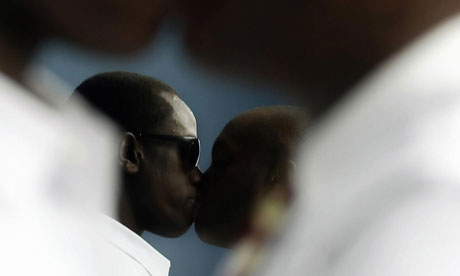
[We are so proud of IRMA Steering Committee Larry Misedah - shown on the left in the pic below. His compelling story is a must-read. Of note, Larry will be joining a group of IRMA members in Addis Ababa this December for Project ARM - Africa for Rectal Microbicides organizing and strategizing activities taking place in advance of the ICASA 2011 conference.]


via Bay Area Reporter, by Heather Cassell

Excerpt:

Until recently, Kenyan LGBT individuals were isolated, believing they were the only ones in their community; some expressed the desire to take their own lives, said Misedah. Older gay and lesbian individuals were forced to marry people of the opposite sex. Younger queer Kenyans felt comfort from their problems with alcohol, said Misedah, who also felt the cold hand of isolation until he came out.

Coming out liberated Misedah, he no longer suffered from the isolation and instead became a beacon for others.

"I felt sort of obliged in order to speak for those who did not have a voice," said Misedah. "I just felt that we needed to speak more and let the society know the challenges that LGBTI people were facing."

He worked first with Ishtar MSM, one of Kenya's first organizations to provide health services to men who have sex with men. He served as the spokesman for Sexual Minorities Uganda's first media campaign. Misedah, in collaboration with IGLHRC, drafted the first Declaration on Transgender Rights for Central and East Africa in 2007 and continued to work on capacity building in Africa with IGLHRC. He spoke at the African AIDS conference in 2009.

Misedah, among others, risked the threat of up to 14 years of imprisonment under Kenya's penal codes sections 162 and 165 for attempted or homosexual behavior under "carnal knowledge against the order of nature."

Misedah, who came from a well-to-do family, found himself banished from his family and cut off from his educational support at the university, where he eventually obtained his bachelor's degree in environmental planning and management, he said.

Usually, families look the other way in regards to their LGBT family members who have financial resources and contribute to their families. Poor queer Kenyans, however, often find themselves in "deep trouble," said Misedah.
Read the rest.


[If an item is not written by an IRMA member, it should not be construed that IRMA has taken a position on the article's content, whether in support or in opposition.]

Non-communicable diseases (NCDs) and HIV fight for resources in Kenya

via PlusNews Global

"NCDs are sexy now, last year it was maternal health; there doesn't seem to be a genuine commitment by government to fully address any of these issues... where are the results? The government must not forget about people living with HIV," said James Kamau, coordinator of the Kenya Treatment Access Movement. "Where is the 15 percent they promised - that way, we could improve treatment of all illnesses."

The crowd of health issues jostling for a share of Kenya's inadequate health budget is expanding, with activists calling for an increase in resources for the management of non-communicable diseases (NCDs), which account for more than 50 percent of hospital deaths and admissions.

"We need to see more commitment in terms of resources; we have policies and guidelines for the management of non-communicable illnesses, but we need strategic focus on operational implementation," said Andrew Suleh, medical superintendent of Mbagathi District Hospital in the Kenyan capital, Nairobi.

According to the NGO, NCD Alliance, NCDs are responsible for more than half of all hospital admissions and deaths; 13 percent of deaths are due to cardiovascular disease, while cancers account for 7 percent and diabetes for 4 percent of deaths, respectively.

Read the rest.


[If an item is not written by an IRMA member, it should not be construed that IRMA has taken a position on the article's content, whether in support or in opposition.]

New Guidelines on HIV Programming for MSM

Via IRIN.

HIV and gay rights activists say new guidelines released by the UN World Health Organization (WHO) on HIV programming for men who have sex with men (MSM) will not only improve health service provision for MSM, but will also act as an advocacy tool in the fight for the rights of this marginalized population.

"The document provides well-researched and evidence-based recommendations for HIV prevention and treatment of MSM, which will be useful for clinicians," said Kevin Rebe, a doctor with Health4Men, a South African health service provider which caters specifically for MSM. "The language of the paper is couched in human rights, and makes a strong call for decriminalization of same sex sexual activity, so it will also be useful for activists seeking to end discrimination."

The guidelines are designed for use by national public health officials and managers of HIV/AIDS and STI (sexually transmitted infections) programmes, NGOs and health workers. They contain MSM-specific programme activities such as the use of water- and silicone-based lubricant for the correct functioning of condoms during anal sex.

The guidelines do not advise medical male circumcision - a measure WHO recommends for HIV prevention among heterosexual men - for HIV prevention among MSM due to the lack of sufficient research on its effect of its use in MSM sexual activity.

They further recommend that health services adhere to the principles of medical ethics and the right to health, and ensure that MSM feel comfortable enough to seek medical care, with MSM-specific health needs catered for within national health systems.

"Like many other African countries, all men in South Africa are assumed to be straight, so health workers are not aware of the need to identify people of different sexualities during consultations; outside of centres like ours, there is little competency in providing health care to MSM," said Rebe. "By availing this knowledge, the guidelines will empower health workers to provide better care to MSM."


Wake-up call

In countries like Uganda, where homophobia is deeply entrenched both within society and the law, gay rights groups hope the new guidelines will serve as a wake-up call to the government about the need to include MSM in HIV programming.

"I hope the new guidelines will be an eye-opener to the government, who have so far ignored MSM within HIV prevention, treatment and support; it should show them that MSM exist in Uganda and are at high risk," said Frank Mugisha, executive director of the NGO Sexual Minorities Uganda. "They therefore cannot be ignored and urgently require HIV interventions."
 
Read the rest here.

[If an item is not written by an IRMA member, it should not be construed that IRMA has taken a position on the article's content, whether in support or in opposition.]

New Light Shed on Male Sex Work


Commercial sex work, dominated by a focus on women, could be redefined as new research launched today in Nairobi, Kenya, sheds light on the complicated HIV prevention needs of what may be Africa’s most deeply underground group at high risk of HIV - male sex workers.

The report co-authored by the United Nations Development Programme (UNDP) and South Africa's Sex Workers Education and Advocacy Taskforce (SWEAT) seeks to better understand the social contexts, sexual practices and risks, including that of HIV, among these men.

The professional debut of many of the 70 male sex workers surveyed in Kenya, Namibia, South Africa, Uganda and Zimbabwe was often prompted by the family rejecting the men’s sexual orientation; for others, it was a way to survive in a foreign country.

Men reported being at risk of HIV in many ways, including the unavailability of speciality health services, the premium clients placed on unprotected sex, violence and the lure of substance abuse. Although the work often placed them at risk of substance and physical abuse as well as HIV infection, the researchers found that it also provided the men with a sense of freedom and empowerment.

The report cautions that mitigating these risks may require specialised HIV prevention services unlike those targeted at female commercial sex workers or men who have sex with men (MSM).

A series of interviews with male sex workers at a five-country workshop in Johannesburg, South Africa, and country visits to Kenya and Namibia has produced a significant addition to the paucity of data on male sex workers, according to Paul Boyce, a UNDP researcher.

While data on MSM from Malawi, Namibia and Botswana indicated that about 17 percent were HIV positive - almost twice the national prevalence rates of their respective countries - not much has been written on the specific HIV risks of male sex workers, which may be higher than those of MSM.

While male sex workers reported working at a range of venues, including Namibian truck stops and Zimbabwean mines, most of the available information on male sex work has come from those operating in the sex tourism hot spot of Mombasa, Kenya, with limited data from a 2009 study in South Africa that showed male sex workers were twice as likely to engage in anal sex than MSM who were not selling sex.


Not necessarily the same old risks:

Unprotected receptive anal sex carries almost 20 times the HIV risk associated with unprotected vaginal sex.

Interviewees told researchers that the unavailability of water-based lubricant, which reduces the risk of condoms breaking during anal sex, and the higher financial reward of unprotected anal sex, made consistent condom use difficult.

Some clients forced unprotected intercourse on sex workers, while others admitted to practicing unsafe sex due to the disinhibition often brought about by the drug and alcohol abuse that is reportedly part of the social scene in sex work. Drugs and alcohol also helped the men mentally cope with the omnipresent risks of this lifestyle, including police harassment.

South African male sex workers said substance abuse - not HIV infection - was the greatest threat to their health.

Those who tried to access health services for HIV testing and treatment, or the diagnosis of sexually transmitted infections (STIs), reported being ridiculed and stigmatized by health workers, even in countries like Kenya, where the Ministry of Health has introduced new guidelines on MSM and sex work, and health and HIV.

"[At the] government hospital, the nurses just [stand] in front of everyone and shout out loud to the people waiting for assistance: 'If you have HIV, go to room nine, TB room 12, STD [sexually transmitted disease] room 8,'" said one man quoted in the report.

Read the rest here.

[If an item is not written by an IRMA member, it should not be construed that IRMA has taken a position on the article's content, whether in support or in opposition.]

KENYA: Rural MSM Too Afraid to Access HIV Health Services

Via PlusNews.

Discriminatory laws and a largely homophobic society mean that men who have sex with men (MSM) in Kenya generally find it difficult to access HIV-related information and health services, but rural MSM have an especially hard time.

When Kibet Kipsowen*, 30, a cattle keeper in Kenya’s Rift Valley Province, and his partner have sex, they use the oil-based jelly he applies when milking his cows; he’s never heard of a water-based lubricant, let alone used one. “Milking jelly is the only lubricant I have known for the last four years,” he told IRIN/PlusNews at his home in the village of Lanjuera.

Health practitioners discourage the use of oil-based lubricants for anal sex, as the oil degrades condoms, increasing the likelihood that they will break. Studies have found that most African MSM use oil-based lubricants, heightening their risk of contracting HIV.

According to a 2008 Modes of Transmission study conducted by UNAIDS and the government, MSM and prisoners account for 15.2 percent of new HIV infections in Kenya annually.

Kipsowen and his partner have been an item for a few years now, but dare not let anyone in their village know they are a couple. “Even people who have ‘normal’ sex do not speak about it - I can never reveal my sexuality or else I would risk being an outcast, or even be killed,” he said.

The only other person in the village who knows about his sexuality is Soita Wellapondi, a local nurse and social worker, and that’s only because Kipsowen visited her when he developed a sexually transmitted infection.

“At that time I had a lot of wounds in my anus; I felt so much pain that I thought I would die, yet I could not even confide to my own mother, brother or sister, and I could not visit a health centre,” he said.

He knew that by confiding in Wellapondi he risked his secret being revealed to the community, but he felt she was his only chance of accessing health care. “I bought him some antibiotics and pain killers; it was absolutely impossible to convince him to visit a health centre, even one far away where he is not known,” said Wellapondi.

Local health workers have very little experience and no training in dealing with MSM. A clinical officer at the Mogotio health centre near Lanjuera says he has only ever had one MSM client.

Even people who have 'normal' sex do not speak about it - I can never reveal my sexuality or else I would risk being an outcast or even be killed“He came here for treatment of injuries resulting from anal sex, and was advised to come for further treatment but he never came back,” said the clinical officer, who declined to be named.


Read the rest here.

[If an item is not written by an IRMA member, it should not be construed that IRMA has taken a position on the article's content, whether in support or in opposition.]

KENYA: Protest as government grapples with HIV funding shortages

via PlusNews

Hundreds of Kenyan AIDS activists held a protest on 18 May in the capital, Nairobi to demand that the government meet its commitment to increase annual health and HIV funding.

"The Minister of Finance promised an annual budgetary allocation increase of 10 percent to health and HIV - we demand that this promise be kept," Davis Njuguna, an AIDS activist with the National Empowerment of People living with HIV/AIDS in Kenya (NEPHAK), told IRIN/PlusNews during the rally. "We cannot pledge to end AIDS without increasing funding to it. Access to HIV treatment is a right and we are not accepting lip service any more."

Marching along Nairobi's busy Thika Road, protesters waved posters urging Finance Minister Uhuru Kenyatta and US President Barack Obama - who pledged during his presidential campaign to provide US$50 billion to fight HIV globally by 2013 - to keep their promises. Other placards read, "You Talk, You Talk, We Die!" and "Broken Promises Kill!"

Read the rest.


[If an item is not written by an IRMA member, it should not be construed that IRMA has taken a position on the article's content, whether in support or in opposition.]

LGBT activist talks challenges in Kenya

via Yale Daily News, by Mohammad Salhut

In Kenya, even some health workers who provide services to men who have sex with men are homophobic, LGBT activist Rachel Mandel said.

Mandel, a former employee for the International Center for Reproductive Health, spoke to 12 professors and graduate students in Luce Hall Wednesday about the difficulties of advocating for gay rights in Kenya through public health organizations.

While employees of these organizations aim to improve health standards for local communities, Mandel said often the employees do not support their patients’ sexual orientations and act in homophobic ways.
 
“The whole gay rights thing has a whole different place there than it does here,” she said.

Part of the problem, Mandel said, is the large chasm between what the administrators of non-profit organizations think is happening on the ground, and what is actually taking place.

Despite the organizations’ policies on equal treatment for patients, many employees at the two organizations Mandel worked for were “incredibly” homophobic, she said.

“The first time that I went I had tour of city of Mombasa by a staff member of ICRH,” she said. “At one point during the car ride he talked about homosexuality and referred to it as a psychological distortion. This same employee later became the head of the [Men who have sex with men] project.”

Read the rest.

[If an item is not written by an IRMA member, it should not be construed that IRMA has taken a position on the article's content, whether in support or in opposition.]

Kenya: Ongeri Warns Students On Homosexuality

Via allAfrica.com, by Henry Wanyama (reported April 19)

EDUCATION minister Sam Ongeri yesterday asked students to shun homosexuality. Ongeri said homosexuality is one vice that the ministry for education must stump out. He said: "I am not threatening anybody but you all know that homosexuality is illegal." Ongeri spoke at the Bomas of Kenya when he opened the third national students' leadership conference. The conference has attracted 1,500 student leaders from across the country who are deliberating on the theme: Education Reforms, Students Perspective.

The minister said, however, he had no clue on the extent of homosexuality but asked teachers, students and everybody in society to know one another so as to be able to fight the vice.

"Homo sexuality is unhealthy and does not add any value to your life. Those who practise are easily infected with HIV/Aids," Ongeri said. He told students that as leaders in their respective schools they should help defeat the vice and the Education ministry is ready to render support. Ongeri said the student leaders' contribution at the conference will be taken to account by the task force collecting views on how the current education system can be aligned to the new constitution.

The minister revealed that very soon the ministry will launch a management guide to extracurricular activities. He also called on students to act as a cushion to society as we approach the 2012 general elections and not to be incited by politicians.

Read the rest

[If an item is not written by an IRMA member, it should not be construed that IRMA has taken a position on the article's content, whether in support or in opposition.]

Kenya: Counselling, not alarm device, had best effect on ART adherence

Via aidsmap, by Carole Leach-Lemens

Patients in Nairobi, Kenya getting intensive early adherence counselling when starting antiretroviral therapy were 29% less likely to have poor adherence and 59% less likely to have virological failure compared to those getting no counselling Michael H Chung and colleagues reported in a randomised, controlled trial published in the March issue of PLoS Medicine.

The positive effects of counselling on adherence were seen immediately after starting antiretroviral therapy and maintained throughout the18 month follow-up period. Use of an alarm device had no effect on adherence or virological outcomes. Public health concerns that scale-up of antiretroviral treatment in sub-Saharan Africa would lead to poor adherence and widespread drug resistance have been proven wrong, note the authors.

The authors conclude “as antiretroviral treatment clinics expand to meet an increasing demand for HIV care in sub-Saharan Africa, adherence counselling should be implemented to decrease the development of treatment failure and spread of resistant HIV.”

Read the rest

[If an item is not written by an IRMA member, it should not be construed that IRMA has taken a position on the article's content, whether in support or in opposition.]

Fearing No Evil

Via Poz, by Regan Hofmann with Oriol R. Gutierrez Jr.

David Kuria works for the Gay and Lesbian Coalition of Kenya where he risks his life daily to provide safe sanctuary and advocacy for the rights of lesbian, gay, bisexual and transgender people in Africa and around the world.

Now, he is running for Kenya’s Senate. A basic tenet of his work is showing that a global push for gay rights helps bolster the fight against HIV. His dream? A day when no LGBT person has to choose between being openly gay—or being killed.

In October 2009, David Bahati, a member of Uganda’s parliament, proposed an “Anti-Homosexuality Bill” (a.k.a. the “kill the gays bill”). It was an attempt to legalize a phenomenon spreading around the world: hate crimes against gay people.

Homosexuality is currently illegal in Uganda (and can result in up to a 14-year jail sentence); Bahati’s proposed bill intensifies the criminalization of homosexuality by introducing the death penalty for people who have previous convictions, are HIV positive, or engage in same-sex acts with people younger than 18. The bill also includes provisions for Ugandans who engage in same-sex relations outside the country—people can be sent back to Uganda for punishment.

Not that there are many safe places to go; laws against same-sex relations exist in nearly 80 countries. Finally, the bill outlines penalties for individuals, companies, media organizations or nongovernmental organizations that support LGBT rights. (As in, if you know your neighbor’s gay and don’t say so, you can get into huge trouble yourself.) It engenders nothing short of a witch hunt.

Read the rest

[If an item is not written by an IRMA member, it should not be construed that IRMA has taken a position on the article's content, whether in support or in opposition.]

Kenya: Testing the Integration of HIV and public healthcare

Via PlusNews

HIV could lose its "special status" in Kenya's health system if a new pilot programme integrating HIV care and public healthcare proves successful.

Traditionally, public hospitals in Kenya have a "comprehensive care clinic" (CCC) dedicated to people living with HIV; under the new system, these would no longer exist.

For more than six months, the Ministry of Health and its partners have been piloting the move in Western Province; senior government officials say it will not reduce the focus on HIV, but will ease pressure on an already overburdened and understaffed health system.

"Integrating HIV treatment with other outpatient services doesn't mean it has become less important; it only means maximizing on space and reducing the burden on healthcare personnel and to help increase focus on other equally important diseases like malaria," said Ibrahim Mohamed, head of the National AIDS and Sexually transmitted infections Control Programme, NASCOP.

Joshua Omoro likes the new system, stating, "I have come today to pick my [antiretroviral] medicine but nobody can know; people are just guessing what I might be suffering from just like I am also just guessing for other people," he said. "It puts you at ease... before when you went to a specific room, people just knew you had HIV."

"It is not only reducing stigma but is also easing the staff shortages that had been experienced earlier when too much focus was placed on HIV/AIDS," said Beatrice Misoga, HIV/AIDS integration officer for US government-supported AIDS, Population and Health Integrated Assistance II (APHIA II) in Western Kenya.

Read the rest

[If an item is not written by an IRMA member, it should not be construed that IRMA has taken a position on the article's content, whether in support or in opposition.]

AFRICA: Need for systematic HIV drug resistance testing

 via PlusNews

HIV is a tough enough diagnosis, but when one contracts a strain of HIV resistant to some life-prolonging medicines, treatment options are limited. A new study has found that transmitted HIV drug resistance may be on the rise in Africa, and the authors warn that unless resistance surveillance is increased, the continent's treatment programmes could suffer.

The study, led by the International AIDS Vaccine Initiative (IAVI) in five African countries, found that the prevalence of transmitted drug resistance in Rwanda, Uganda and Zambia was considerably higher than previously reported. Of 408 people studied in Kenya, Rwanda, South Africa, Uganda and Zambia, 19 had transmitted resistance mutations. Resistance prevalence rose considerably during the study in Zambia and remained high throughout the study in Entebbe (Uganda).

"The message to take away from this study is the urgent need for regular drug resistance surveillance, which we currently do not have," said Omu Anzala, head of the Kenya AIDS Vaccine Initiative. "If we can see transmitted resistance in such a small study then there could be much more going around."

"We saw what has happened with malaria over the years, with resistance developing against several drugs. We need to move quickly to ensure governments are aware and are implementing drug resistance surveillance to prevent the same thing happening with ARVs," he added.

In 2009 Kenya launched a five-year national plan on HIV drug resistance, prevention, monitoring and surveillance.

A separate study in 2010 by PharmAccess African Studies to Evaluate Resistance (PASER), a project of the PharmAccess Foundation, a Dutch health NGO, found that nearly 6 percent of patients about to start HIV treatment for the first time already had resistance to standard first-line ART.


[If an item is not written by an IRMA member, it should not be construed that IRMA has taken a position on the article's content, whether in support or in opposition.]

VIDEO: Melvin and his sister: A gay Kenyan's struggle to survive

via guardian.co.uk

As discrimination against homosexuals in Africa reaches a new murderous peak, Guardian Films travels to Mombasa, Kenya, to hear from a male prostitute who risks his life to support his younger sister.


[If an item is not written by an IRMA member, it should not be construed that IRMA has taken a position on the article's content, whether in support or in opposition.]
K24TV - The price of protection in Kenya is too high


[If an item is not written by an IRMA member, it should not be construed that IRMA has taken a position on the article's content, whether in support or in opposition.]

KENYA: Stigma keeps Asian population from accessing HIV services

via PlusNews

When 20-year-old Jenna,* a Kenyan of Asian descent, told her family two years ago she had tested positive for HIV, they forced her to terminate her pregnancy, forbad her to seek treatment and kept her locked in the house because of the shame she had brought on the family.

She did, however, go against their will and obtained life-prolonging antiretroviral medication at hospital. She now lives with another family who have taken her in and accepted her status.

"When I insisted on seeking treatment, my family chased me away," Jenna told IRIN/PlusNews. "For them it was good if I died slowly rather than shame them by seeking treatment and giving people an opportunity to know my status."

The Kenya National Bureau of Statistics estimates there are about 120,000 Kenyans of Asian - largely South Asian – origin, mainly living in the three major cities of Nairobi, Mombasa and Kisumu.

According to Anwar Ali Sharif, 36, the only Asian member of the National Empowerment of People Living with HIV/AIDS of Kenya (NEPHAK), stigma is the biggest impediment to Kenyan Asians accessing HIV/AIDS services.

"There is a lot of stigma among Kenyans of Asian origin. Many people who are HIV-positive are locked in the house because it is feared they will shame the family if it is known they are HIV-positive," he said.

He noted that while wealthy Asians could afford to visit private health facilities where no one need know their status, the stigma of visiting the clearly marked comprehensive HIV care clinics in public hospitals kept poorer Asians away from treatment.


[If an item is not written by an IRMA member, it should not be construed that IRMA has taken a position on the article's content, whether in support or in opposition.]
 

Kenya: How discrimination is a barrier to good health

via guardian.co.uk

Complex issues, such as health and poverty, are often best illustrated by following individuals and showing how the issues affect their lives. That is why the Guardian is producing a series of films about some of the global issues that feature in Christian Aid's manifesto for change, Poverty Over.

The first film – on sexuality-based discrimination, human rights and HIV in Kenya – is available to view here on the Guardian's Christian Aid website from Monday. Same-sex relationships are illegal in the country, but prejudice and fear about them go far deeper than that. This film shows how hatred has a negative impact on the health of gay people in Kenya.

Anti-gay feeling is common in Kenya. Some politicians, religious leaders and sections of the media have stirred up this hatred. In November last year, for instance, the prime minister, Raila Odinga, called for a nationwide crackdown on gay people. Odinga ordered the police to arrest anyone found having sex with someone of the same gender and said that the country's constitution made it clear that homosexual activity was not to be tolerated.

This has obvious implications for men who have sex with other men, as they are often unable to access care if they become infected with HIV. Clinics that are known to treat gay men are threatened, medical practitioners may be unwilling to help them, they are often isolated and unable to access any kind of information. Many of these men are married, and risk infecting their wives with HIV.

The red-light areas of large cities in Kenya also show that, despite the rhetoric, there is a thriving gay sex industry. Many of the male sex workers have been thrown out of their family homes for their sexuality; they report that they are often compelled by clients to have sex without condoms.

Yet a growing gay community, and some inspiring gay rights and HIV activists, are doing their best to ensure that more people in Kenya are made aware of safer sex, condoms are made available, and prejudice against men who have sex with other men is addressed.

To find out more, view the film online from Monday, March 14. The site also has other interesting content that will engage, outrage, inspire and inform you, including Thursday webchats (1pm-2pm) when you can post questions for Christian Aid advisers. Additional films will be uploaded every week.

Source.

[If an item is not written by an IRMA member, it should not be construed that IRMA has taken a position on the article's content, whether in support or in opposition.]

Kenya: Anal sex - "the modern way" - lies, and HIV

via IRIN PlusNews

For 10 years Amina Hassan*, 37, trusted her husband and had a happy married life in Nakuru, in Rift Valley Province, western Kenya. Even if her religion allowed him to marry other wives, he had always assured her that she was enough, and he would have no reason to marry anyone else. But she told IRIN/PlusNews that life changed when her husband went to work in the port city of Mombasa and he returned a different man.

"I got married in 1994 at the age of 20 to a man who was five years older than me. Every time we talked, he assured me of his love for me and his commitment to making me happy all the time. He said he was faithful to me even though as a truck driver he travelled for long distances and many days.

"In return, I remained faithful to him, I would miss him when he travelled but kept off the temptations of having another partner. He had rented a house for us in Bondeni, Nakuru, and I made sure no man, even a relative, visited in his absence, lest speculations start spreading around.

"In January 2004 he told me he would be working around the costal town of Mombasa for three weeks but... he did not return as promised and told me on the phone that he would take a little longer, as he had been assigned more work.

"When he came back in July the same year, it was a joyous moment for me and our children. But unlike before, the joy did not last over the night.

"He had never before asked to have anal sex with me, but on that particular night he demanded that it had to be done 'the modern way'. When I resisted, he threatened to leave me, saying I and the children would soon die from starvation as he would no longer provide for us.

Read the rest.


[If an item is not written by an IRMA member, it should not be construed that IRMA has taken a position on the article's content, whether in support or in opposition.]

Vision: How Yoga is Transforming a Kenyan City

via AlterNet, by Anna Clark

In Nairobi, the Africa Yoga Project is training HIV+, poor, and disabled citizens to be yoga instructors, creating jobs and changing lives.


Here is what the Africa Yoga Project wants you to know: it is not religious. Nor is it a collective of devil worshippers. If you come to AYP’s free and rambunctious Saturday morning class in Kenya’s capitol city, you will certainly not be lured into practicing an unfamiliar faith. Also, AYP will not give you money to do a few downward dogs.

Given the missionary tradition of East Africa, these are the not unreasonable suspicions AYP instructors face when they invite Kenyans to practice yoga. But just over three years since its founding by American ex-pat and yogi Paige Elenson, AYP has gathered enormous momentum. Those Saturday classes? About 70 people come each week, many traveling some distance to the studio in Sarakasi Dome on Nairobi’s Ngara Road. Students show off their acrobatics before the opening child’s pose—balancing on each others’ knees, pulling themselves vertical.

Throughout the two-hour yoga class in a sunny room marked by colorful graffiti and gleaming mirrors, students noisily whoop and groan and sigh with relief as they move through a vinyasa flow. There is no meditative music playing; the sounds of this studio are all voices and breath and movement. As the teacher of this class rotates, AYP instructors practice alongside newcomers, children, mothers, teenagers, and a handful of ex-pats. Afterward, sitting up on the dusty black mats, everybody claps.

By training yoga instructors who come from the same Nairobi slums that are the center of the program’s outreach, and by making explicit connections to the acrobatic and dance arts many potential yoga students are already doing on street corners, AYP hosts 200 free classes a week, reaching 3,000 students with 42 local yoga instructors. Most students are aged 16-30, living on about $2 a day, and many live with HIV/AIDS.

Read the rest.


[If an item is not written by an IRMA member, it should not be construed that IRMA has taken a position on the article's content, whether in support or in opposition.]

Kenya: "Gays here are just outcasts"

via Voice of America, by Darren Taylor

Excerpt:
Denis Nzioka lives in Nairobi and is one of East Africa’s most prominent gay rights activists.  He works for a variety of NGOs, including the Gay and Lesbian Coalition of Kenya and the Gay Activists Alliance of Africa.

Nzioka says opinions like those of Ichuliza, Wathira and Githui have always been popular in Kenya.  But – fueled by some politicians, religious leaders and “cultural bigots” – he says homophobia’s becoming “much more” common in the country.

“We have had (recent) cases of police beating up gay people.  We have had gay parties being raided by police, or any effeminate guy – maybe in a club – being thrown out by bouncers or the police being called to arrest this person,” Nzioka says.  “We also have cases of gay people being blackmailed.  I know of one well-known Kenyan who has paid blackmailers 200,000 Shillings (about US$ 2,500) to prevent him being exposed as a homosexual.”

According to Nzioka, some Kenyan health institutions are also homophobic.  “We’ve had cases of homosexuals being infected with anal and oral gonorrhea and going to the hospital where doctors refused to treat them,” he says.

He says homophobia is very prevalent in Kenya’s schools.  “We often hear of cases of gay students being discriminated against by fellow pupils and even teachers,” he says.

And in Kenya’s streets, the insults persist.  “Homophobes shout at you, ‘You fag! Homo!   You prostitute!  You are evil; you are immoral.  You are worse than pigs; you are just dogs,” says Nzioka.
Read the rest.


[If an item is not written by an IRMA member, it should not be construed that IRMA has taken a position on the article's content, whether in support or in opposition.]

AVAC helps us understand male circumcision, and its impact on women

from AVAC

 It has been roughly four years since randomized controlled trials of medical male circumcision in Kenya, South Africa and Uganda showed that medical male circumcision is safe and reduces men's risk of HIV infection during vaginal sex by about 60 percent. The advent of this new biomedical strategy has prompted a range of implementation efforts and civil society responses. WHiPT is a response to women’s concerns that emerged from the earliest discussions of this new strategy.

WHiPT released its first findings on male circumcision rollout at the 2010 IAS conference in Vienna. Teams of women in Namibia, Kenya, South Africa, Swaziland, and Uganda were part of the first, pilot phase of this research, focusing on the implications of MMC for women. In all but one region of focus (Nyanza in Kenya), MMC had not yet been rolled out; therefore, the women documented perceptions and concerns around MMC’s pending rollout, not actual or anecdotal experiences of the rollout.

Read the report: Making Medical Male Circumcision Work for Women

[If an item is not written by an IRMA member, it should not be construed that IRMA has taken a position on the article's content, whether in support or in opposition.]